


Forty-three percent. That is the share of cross-border payments that reach the worker's account within an hour. Swift published the figure itself, and it is not a flattering one.
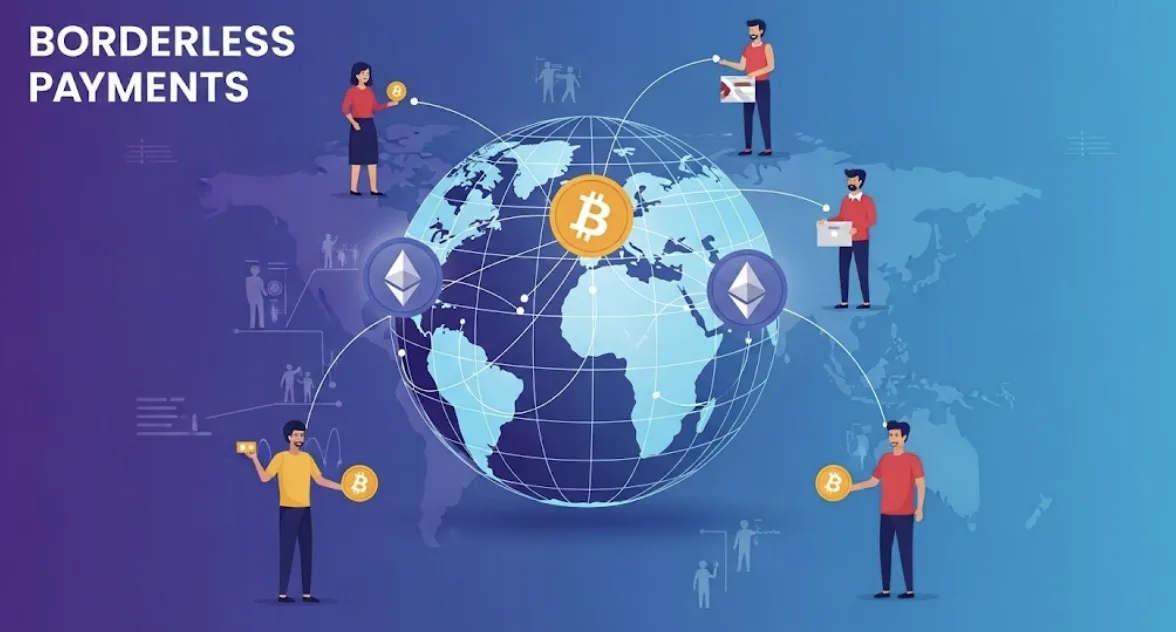
Some teams have stopped waiting for the other 57%. They pay contractors in stablecoins, or keep a crypto reserve and convert Bitcoin to Ethereum when someone prefers ETH. This guide shows how that works in practice, and where it still goes wrong.
Why cross-border pay is still slow and expensive
The money usually leaves on time. The problem is the last stretch.
Swift says 90% of cross-border payments reach the receiving bank within an hour. Yet only 43% reach the end customer's account that fast. The gap is the local leg, after the money has already "arrived."
"[We] need to focus our efforts firmly on the domestic beneficiary leg of transactions," said Thierry Chilosi, Chief Business Officer at Swift.
Cost is the other headache. The World Bank tracks what it costs to send $200 abroad.
In Q1 2025, the global average was 6.49%. Through banks, it was 14.55%.
Channel | Average cost to send $200 (Q1 2025) |
|---|---|
Banks | 14.55% |
Global average | 6.49% |
Money transfer operators | 5.04% |
Digital-only providers | 3.55% |
Source: World Bank, Remittance Prices Worldwide.
The official goal is to get to 3% by 2030. Progress is slow. Back in October 2025, the Financial Stability Board said that global payment costs were "sticky."
How distributed teams use crypto for payroll
There's no one way to do it. Most teams end up with one of three setups, depending on what the worker wants.
In the first scenario, the contractor wants dollars. The team pays in a stablecoin, which is a token that's pegged to the dollar. The contractor gets it in minutes and holds on to it until they need local currency.
This is the most common setup. A survey by Pantera Capital found that 9.6% of crypto professionals are paid in stablecoins. The number paid in digital assets tripled in a year.
In scenario 2, the contractor wants a specific coin. Some people prefer ETH, for example, to use apps on Ethereum. If the team holds a different asset, it swaps first and pays second.
A team that keeps part of its reserve in bitcoin does exactly this. Just one quick swap, then one transfer. There was no bank involved at either step.
In scenario 3, the team holds a crypto treasury. This means that the company keeps some of its operating funds in crypto. It takes money from that reserve as invoices come in.
This setup needs the most discipline. Price swings hit the treasury, not just the payout. Most teams keep payroll money in stablecoins and the rest separate.
How big stablecoin payments really are
The headline numbers can be a bit misleading. McKinsey says that stablecoin volume is as high as "up to $35 trillion" a year. Most of that is trading and internal reorganisation.
Real payments are smaller, but growing fast. McKinsey, using Artemis data, puts them at about $390 billion a year.
- B2B payments: about $226 billion, up 733% year on year
- Payroll and remittances: about $90 billion a year
- Share of all global payments: about 0.02%
"Raw reported volumes should be treated as a starting point for analysis, not as a proxy for payment adoption," McKinsey's authors write.
Visa Onchain Analytics has added a fresh signal. Adjusted stablecoin volume hit a record $1.79 trillion in June 2026. That was up 125% from a year earlier.
Big payroll platforms have picked up on this. Back in June 2026, one of the biggest announced a stablecoin wallet for contractors in over 150 countries.
The hidden costs nobody puts on the invoice
Most comparisons put the wire fee next to the network fee. That misses two bigger costs.
The FX margin
The World Bank has some interesting observations about some providers. Their fees didn't change, but the total cost did, following the FX margin. That's the difference between the real exchange rate and the one you get.
So a "low fee" can still be expensive. The margin is included in the rate.
The float
Money stuck in transit is money nobody can use. For contractors, payday is when they can spend money, not when the money's been transferred.
Crypto basically gets rid of most of the float. A stablecoin transfer is super quick, you'll have the money in minutes, at any time.
But the FX question still hasn't been answered. It moves to the moment the worker converts to local currency.
Cost | Bank wire | Crypto payout |
|---|---|---|
Visible fee | Wire fee | Network fee |
Hidden fee | FX margin on the rate | Spread when swapping or cashing out |
Waiting time | Hours to days on the last leg | Minutes |
Can be reversed | Sometimes | No |
We'd compare the all-in landed amount instead. How much did the worker actually receive, and when? That one number settles most debates.
Accounting, tax and compliance
This is where a lot of teams go wrong. Just so you know, you'll still need a clean record to pay with crypto.
Under IFRS rules, crypto isn't considered cash. It's usually counted as an intangible asset, or inventory if it's held for sale. Your accountant will need to know the date, amount and rate of each payout.
Reporting is getting more and more strict too. The OECD's Crypto-Asset Reporting Framework is now in effect in 48 jurisdictions, having come into force on 1 January 2026. Tax authorities will start automatically sharing data in 2027.
The rules about compliance are all about the money too. Travel Rule laws have been passed or are in the works in 99 jurisdictions. The FATF is pretty clear about it:
"Most on-chain illicit activity now involves stablecoins."
That does not make stablecoins bad. It means the people sending them get asked more questions.
Why a SimpleSwap account fits team payouts
For one-off swaps, a guest checkout can feel enough. For a team that pays every month, an account changes the picture.
- Exchange history in one place. Every swap is logged. Your accountant gets dates and amounts without screenshots.
- Price alerts. Set a target rate before payday, and swap when it hits.
- Loyalty discounts that build up. Bronze comes with sign-up and gives 5% off service fees. A team swapping 10,000 USDT in total reaches Silver and 10% off. Levels never expire.
- Address book in the app. Save each contractor's wallet once. Fewer copy-paste mistakes on payday.
Going through KYC adds more. SimpleSwap says verified users often get better pricing and quicker swaps.
They also get full access to address data, including a PDF report. That helps when a new contractor sends a wallet you have never paid before.
Verification is optional and takes about 24 hours. For a team with regular payouts, it pays for itself in saved hassle.
FAQ
Is it legal to pay contractors in crypto? Rules differ by jurisdiction. Many allow it, but tax reporting still applies. Check with a local accountant before you start.
Which crypto is best for paying a distributed team? Most teams use stablecoins, since they track the dollar. Volatile coins suit only workers who ask for them.
How fast is a crypto payout? Usually minutes. It depends on the network and on confirmations.
Can a crypto payment be reversed? No. A sent transfer cannot be pulled back. Always run a small test payment to a new address first.
What records should a team keep? Date, amount, asset, exchange rate and wallet address for every payout. An exchange history makes this much easier.
Back to that 43%. For a contractor waiting on the last leg, the fix was never a faster wire. It was a payment that arrives where they can actually use it.
Sources: Swift press release on cross-border processing speed (Oct 17, 2024); World Bank Remittance Prices Worldwide, Q1 2025 report; Financial Stability Board, G20 Roadmap progress report (Oct 9, 2025); McKinsey, "Stablecoins in payments: What the raw transaction numbers miss" (Feb 18, 2026), with Artemis data; Visa Onchain Analytics via Cointelegraph (Jul 6, 2026); Pantera Capital compensation survey via Cointelegraph (Aug 6, 2025); Stripe newsroom (Jun 3, 2026); IFRS Interpretations Committee via EY; OECD CARF coverage via Crowdfund Insider (Jan 4, 2026); FATF Targeted Update on Virtual Assets (Jun 26, 2025); SimpleSwap FAQ, Loyalty Program and KYC pages (Oct 2026).
This article is for information only and is not financial, legal or tax advice.



