1. Plan Your Data Scientist Interview
Start with the decisions and tasks this data scientist will own. Select questions that ask candidates to explain their reasoning, project contributions and trade-offs, rather than treating every tool or background example below as a requirement.
Use targeted questions and consistent evaluation frameworks to compare answers against the role’s requirements, not the polish of a resume or portfolio.
Jump to: Interview questions · Scoring candidates · Quick interview checklist.
2. Core Traits to Look for in Data Scientist Candidates
When interviewing candidates, assessing core traits ensures you identify individuals who can thrive in data-driven environments:
- Statistical Intuition: Ask candidates to demonstrate probabilistic reasoning and experimental design through examples, including how they addressed data limitations.
- Analytical Thinking: Strong analytical thinkers can deconstruct complex datasets, spot patterns, and form hypotheses, which is essential.
- Domain Knowledge: Familiarity with the specific industry (e.g., finance, healthcare, e-commerce) helps candidates contextualize data insights and drive relevant business outcomes.
- Data Fluency: A deep understanding of data manipulation, cleaning, and transformation techniques ensures candidates can prepare datasets effectively, a critical skill.
- Communication: Clarity in translating technical findings into actionable insights for non-technical stakeholders is vital.
- Problem-Solving: The ability to frame vague business questions into well-defined analytical tasks helps candidates navigate ambiguity and craft robust solutions.
3. Personal and Career Background
Interviewing Data Scientist candidates often reveals a blend of formal education and diverse professional experiences. Treat these examples as discussion prompts, not required paths or proof of competence; ask about each candidate’s contribution and reasoning.
- Bachelor’s or Master’s in Quantitative Fields: Common degrees include Statistics, Mathematics, Computer Science, or specialized Master’s in Data Science.
- Industry Exposure: Successful candidates often come from tech, finance, healthcare, retail, or consulting backgrounds, where they applied analytics to real-world challenges.
- Prior Roles: Typical career paths include Data Analyst, Business Intelligence Analyst, Analytics Consultant, or Machine Learning Engineer before stepping into Data Scientist positions.
- Portfolio and Projects: Many candidates maintain Kaggle profiles, GitHub repositories, or personal dashboards to showcase end-to-end projects. Ask what they contributed and why they made particular choices.
- Interdisciplinary Collaborations: Experience working alongside engineers, product managers, and domain experts indicates an ability to bridge technical and business domains.
4. Technical Skills and Experience
Select skills relevant to the role; assess applied reasoning and project contributions, not tool familiarity alone:
- Programming in Python or R: Fluency in Python (pandas, NumPy) and/or R empowers candidates to build and test models efficiently.
- SQL and Database Management: Strong SQL skills enable candidates to extract and manipulate large datasets.
- Machine Learning Frameworks (scikit-learn, TensorFlow, PyTorch): Ask candidates to explain how they used these libraries to design, train, and validate predictive models.
- Statistical Modeling: Proficiency in regression, classification, and time-series analysis demonstrates a candidate’s ability to derive meaningful inferences from data.
- Data Visualization Tools (Tableau, matplotlib, Plotly): The ability to create clear, impactful visualizations helps candidates communicate insights effectively.
- Big Data Technologies (Spark, Hadoop): Ask for examples of processing large-scale datasets when distributed computing is relevant to the role.
- Cloud Platform Experience (AWS, Azure, GCP): Ask how candidates deployed models and managed data pipelines, including steps taken for scalability and reproducibility.
5. Soft Skills
When interviewing data scientist candidates, assess job-relevant communication and collaboration behaviors alongside technical skills:
- Communication: Clear articulation of analytical findings and active listening help bridge gaps between data teams and business stakeholders.
- Working Across Perspectives: Ask how candidates clarify stakeholder needs, share information and work through different priorities in situations relevant to the job.
- Conflict Resolution: The ability to navigate disagreements on model assumptions or data interpretations fosters productive discussions and stronger solutions.
- Self-Awareness: Candidates who recognize their strengths and limitations know when to seek mentorship or collaborate with cross-functional teams.
- Adaptability: The capacity to adjust to evolving project requirements, new tools, or unexpected data challenges is essential for thriving in dynamic environments.
- Collaboration: Effective teamwork ensures data initiatives align with organizational goals, making this skill crucial.
6. The Best Interview Questions to Ask and Why
Asking targeted questions when interviewing candidates uncovers technical prowess, problem-solving aptitude, and communication skills.
Choose the role’s core questions before interviews. OPM’s structured-interview guidance describes asking all candidates the same predetermined questions in the same order and using common rating standards. As practical follow-up guidance, agree probes beforehand and use them consistently; record the answer evidence they elicit.
- “Can you describe a project where you developed a predictive model from scratch, including feature engineering and evaluation metrics?” This reveals a candidate’s end-to-end modeling approach and understanding of validation techniques.
- “How do you approach feature selection, and what methods do you use to prevent overfitting?” This uncovers technical depth in statistical best practices and model robustness, critical for success.
- “Tell me about a time you communicated complex analysis results to non-technical stakeholders—what challenges did you face and how did you overcome them?” This probes communication skills and ability to tailor insights.
- “What techniques do you use to handle missing data or outliers, and why would you choose one approach over another?” This evaluates practical data preprocessing strategies and statistical reasoning.
- “Describe a scenario where you chose between multiple algorithms for a classification problem—how did you compare and decide?” This demonstrates algorithm selection skills and performance benchmarking.
- “How do you validate the fairness and bias of your models, and what steps do you take if you detect issues?” This examines ethical considerations and model governance, which are increasingly important.
- “Can you walk me through a time you optimized a data pipeline for large-scale processing—what tools and architectures did you use?” This highlights experience with big data technologies and infrastructure.
- “How do you ensure reproducibility and version control for your analyses and models?” This uncovers best practices in code management and experiment tracking.
- “What is your experience with deploying models into production, and what challenges have you encountered?” This assesses deployment readiness and operational awareness, critical for candidates.
- “How do you stay current with emerging data science trends and tools?” This tests continuous learning mindset and adaptability.
7. Good vs. Bad Interview Questions
Good interview questions are open-ended, behavior-based, and scenario-focused, enabling recruiters to delve into a candidate’s analytical process, decision-making rationale, and collaboration style. For example, asking “Describe a project where you mitigated data bias in your model, what steps did you take?” encourages detailed responses and reveals technical and ethical acumen.
In contrast, bad questions are leading or vague, providing minimal insight into a candidate’s thought process or real-world capabilities. Yes/no checks can establish factual screening information, but are not enough to assess reasoning. For instance, asking “Do you know how to use Python?” offers little understanding of depth or practical experience. Use an agreed follow-up asking for an example of how the candidate used it.
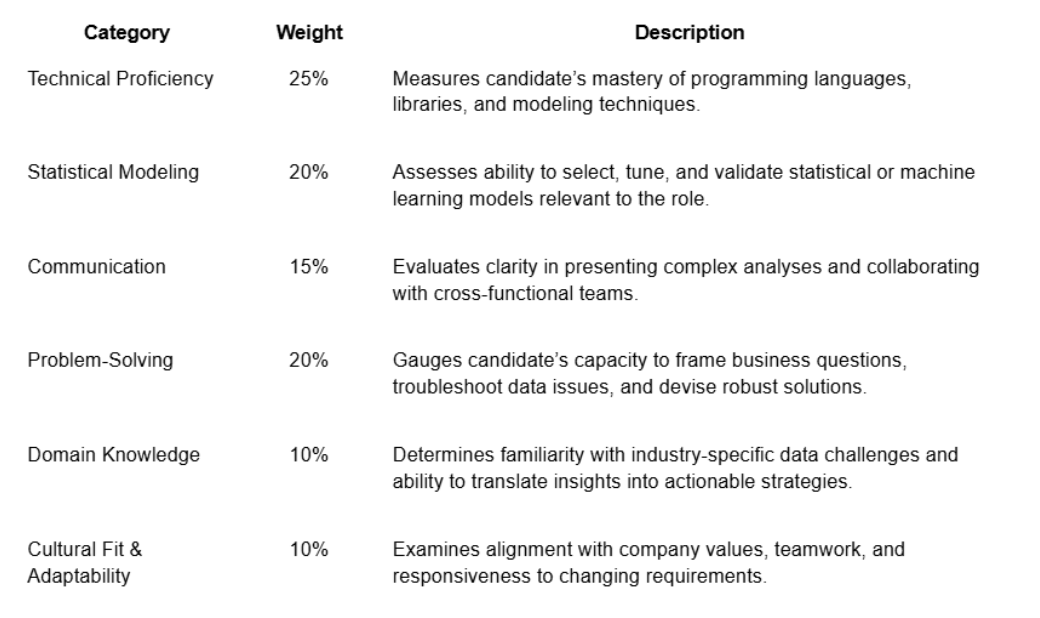
8. Scoring Candidates Properly
Agree job-related criteria, any weights and rating standards before interviews. OPM describes structured interviews as evaluating all responses using the same rating scale and standards for acceptable answers. Use those common standards to compare recorded evidence, not to assume that a rubric guarantees fairness or better hires.
Illustrative scoring example: the predictive-model project question
For question 1, adapt these anchors to the role. This is an editorial illustration, not a validated or OPM-endorsed scale:
- Limited evidence: Names methods or metrics without explaining personal contribution, feature choices or evaluation.
- Some evidence: Explains personal contribution, feature choices and an evaluation metric, but gives limited justification for those choices.
- Strong evidence: Explains contribution, feature and validation choices, and metric trade-offs against the project’s objective; discusses data limitations.
Record specific answer evidence beside the rating, including what the candidate did and why. Distinguish missing evidence from demonstrated weaknesses, and use the agreed probes to clarify gaps.
9. Red/Green Flags to Watch Out For
Treat red and green flags as observations to examine against the role’s requirements using agreed probes, not predictions of future performance. Neither jargon nor a polished impact story alone establishes capability or honesty; clarify the candidate’s contribution and reasoning.
Red Flags:
- Reliance on Buzzwords: Candidates who recite jargon without explaining underlying concepts should be asked to explain the method through an agreed probe.
- Vague Explanations: If a candidate cannot articulate reasoning behind model choices, use agreed probes to clarify what they did and why.
- Lack of Version Control Practices: If a candidate cannot describe code management or experiment tracking, use agreed probes to clarify how they tracked work relevant to this role.
- Inflexibility with Tools: Resistance to learn new libraries or platforms needs clarification: ask about prior learning and willingness to use tools required for this role.
Green Flags:
- Thoughtful Data Cleaning Strategies: Candidates who explain considerations for handling missing data and outliers demonstrate practical rigor.
- Clear Impact Stories: Providing specific examples of how analyses influenced business outcomes highlights result-driven mindset.
- Collaborative Project Experience: Evidence of working in cross-functional teams shows strong teamwork and communication skills.
- Emphasis on Reproducibility: Candidates who discuss using version control and documentation indicate a commitment to best practices.
10. Common Interviewer Mistakes
Common mistakes include relying on unstructured or ad-hoc questions that yield inconsistent evaluations, neglecting to calibrate interviewers on key criteria, focusing solely on technical skills while ignoring communication and job-relevant collaboration, and using leading questions that bias responses. Such pitfalls can lead to overlooking qualified candidates or selecting individuals who lack essential collaboration skills, ultimately undermining hiring effectiveness and team cohesion.
11. Tips for the Data Scientist Interview Process
Interviewing Data Scientist candidates benefits from a structured, candidate-centric approach:
- Define a Success Profile: Clearly outline the skills, experience, and traits needed for the role to ensure alignment across all stakeholders.
- Use Structured Scorecards: Use agreed job-related criteria and common rating standards to compare recorded evidence across interviewers.
- Calibrate Your Interviewers: Conduct calibration sessions so interviewers share a common understanding of evaluation criteria and scoring scales.
- Limit Rounds to Key Stakeholders: Streamline interviews by involving only decision-makers, avoiding unnecessary steps that may lead to candidate drop-off.
- Allow Time for Candidate Questions: Encourage two-way dialogue so candidates can clarify expectations and demonstrate engagement, which improves candidate experience.
- Provide Prompt Feedback: Offer timely updates and decisions to maintain candidate interest and reinforce a positive employer brand.
12. How to Run Remote & Async Interviews That Actually Work
In remote or asynchronous interviews, give candidates clear instructions and use an agreed evaluation process:
- Select Appropriate Tools: Use platforms like Zoom, GitHub, and CodeSignal to facilitate screen-sharing, code reviews, and take-home assessments, ensuring smooth interactions.
- Design Realistic Assessments: Assign datasets and modeling tasks that mirror on-the-job challenges, allowing candidates to showcase problem-solving without the pressure of live coding.
- Set Clear Expectations: Provide detailed guidelines on timelines, deliverables, and evaluation criteria so candidates understand how to prepare and what to expect.
- Standardize Evaluation Framework: Apply the agreed job-related criteria and rating standards in both live and asynchronous interviews; record evidence for each rating.
- Ensure Timely Communication: Send updates and feedback promptly to keep candidates engaged and avoid confusion, especially important when processes become asynchronous.
13. Quick Interview Checklist
A concise checklist helps keep the interviewing process streamlined and consistent. Select or combine assessment stages according to the role; not every item needs a separate round.
- Define Role Requirements: Align with stakeholders on must-have skills, experience, and traits before interviewing any candidates.
- Create a Structured Scorecard: Map job-related criteria and any weights (e.g., Technical Proficiency, Problem-Solving) and agree common rating standards before interviews.
- Consider AI-Assisted Resume Screening: If using Litespace’s screening, review its rankings and explanations against your job criteria before deciding who advances.
- Conduct an Initial Phone or Async Screen: Assess communication skills, basic technical knowledge, and job-relevant collaboration behaviors in a brief call or questionnaire.
- Assign a Take-Home Data Challenge: Provide a dataset requiring cleaning, modeling, and visualization to evaluate real-world problem-solving.
- Schedule a Technical Deep-Dive Interview: Ask in-depth questions on algorithms, statistics, and system design to validate core competencies.
- Perform a Behavioral Interview: Use open-ended, scenario-based questions to assess soft skills, collaboration, and adaptability.
- Evaluate Visual Communication: Request a short presentation of findings from the take-home challenge to gauge storytelling and data visualization skills.
- Gather Stakeholder Feedback: Debrief with hiring managers, team leads, and potential collaborators to align on candidate fit.
- Check References: Focus on past performance in data-driven projects, collaboration, and ability to meet deadlines.
- Make a Data-Driven Decision: Review rubric scores alongside supporting interview evidence and stakeholder observations against the role’s requirements, rather than treating the total score as a decision by itself.
- Extend Offer and Plan Onboarding: Communicate next steps clearly and schedule initial training sessions, including introduction to existing data infrastructure.
14. Using Litespace to Improve Your Recruiting Process
Litespace can be an optional aid for preliminary screening. Its product overview describes resume screening that ranks applications against supplied criteria and explains its recommendations, plus brief role-specific pre-screening Q&A based on the criteria and candidate’s resume. Treat these as preliminary inputs for human review, not technical validation; your team remains responsible for hiring decisions.
Try Litespace today to enhance your recruiting process: https://www.litespace.io/
15. Final Thoughts
Use structured interviews and clear evaluation criteria to guide your next hiring discussion. Agree the role’s core questions and rating standards in advance, then review recorded answer evidence with your team after interviews. Apply this preparation to in-person, remote and asynchronous formats.