
.svg)
.svg)

Every week brings another announcement about some company's bold new AI initiative. A few months later? Crickets. The pilot never scaled, the budget got quietly redirected, and everyone's moved on to the next shiny thing.
If this sounds familiar, you're not alone. According to MIT research, 95% of AI projects fail to return on investment. Whether that exact figure holds up to scrutiny is almost beside the point - it resonated because it matches what most enterprise leaders are experiencing.
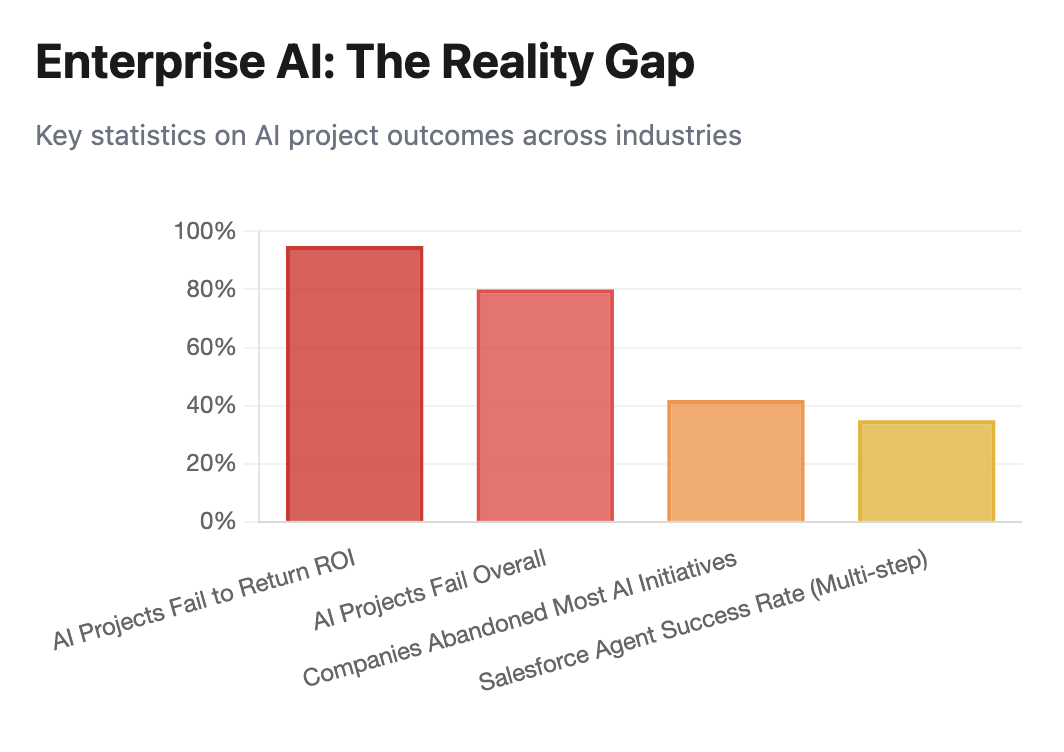
The gap between AI's promise and what actually gets delivered has become impossible to ignore.
The Real Problem Isn't the Technology
Most failed AI projects share the same underlying issues. On the surface, the problems look technical - models hallucinate, integrations lag, nobody actually uses the thing. But dig deeper and you'll find structural mismatches between today's tools and how large organisations actually work.
Four Reasons Enterprise AI Keeps Failing
1. Generic SaaS platforms aren't built for your business
The market's full of vendors slapping "AI-ready" or "agentic" labels on their products. Gartner estimates that out of thousands claiming to offer agentic AI, fewer than 130 are genuine. This wave of "agentwashing" has left organisations trapped in expensive dead ends with rigid systems that don't match their actual workflows.
2. Models are disconnected from your data
Even powerful AI models produce unreliable results when they can't access your proprietary information. Without proper grounding in enterprise data, they hallucinate - fabricating convincing-sounding answers to fill gaps they can't see. You get the appearance of intelligence without the dependability you need.
3. The interfaces don't match how people work
Research consistently shows that tools designed for broad use cases create friction when applied to specific tasks. Employees end up retreating to familiar manual processes because the AI system just gets in the way. The promised productivity gains never materialise.
4. Pilots don't become platforms
Too many companies treat AI as a collection of experiments rather than building toward an operating model. Isolated proofs of concept multiply, each with its own budget and vendor, but few ever scale beyond the team that launched them.
Add to this the uncomfortable truth that many consultancies selling AI transformation simply aren't equipped to deliver it. The Wall Street Journal reported how enterprise leaders from Bristol Myers Squibb, Merck Healthcare, and AmeriSave described Big Four consultancies struggling to turn GenAI pilots into scalable outcomes - with some admitting they were "learning on the client's dime."
Deloitte's refund to the Australian government after delivering an AI-generated report riddled with errors underscores the same issue: those selling AI transformation often don't understand the technology well enough to deliver it.
What Actually Works: Four Elements of Successful AI Implementation
Digital transformation used to mean filling blank spaces - replacing paper trails with databases, manual workflows with digital tools. AI doesn't work that way.
"Dropping a large language model into an existing system or adding a chat interface on top of legacy software doesn't create transformation - it just creates another layer of complexity," explains Leon Gauhman, Co-Founder and Chief Product & Strategy Officer at Elsewhen, a London-based AI consultancy that's developed a different approach. "True productivity doesn't come from adding more tools; it comes from rethinking how work itself gets done in collaboration with a machine."
This machine is fundamentally different from previous technology. It can understand language, code, and images. It can analyse, summarise, and propose solutions. The real opportunity lies in redesigning work so that human and machine operate together, not in sequence.
The Four Foundations
Built for You
Intelligence is now a commodity - the real advantage comes from shaping it to fit your specific needs. Every enterprise has unique data models, workflows, and constraints. Generic SaaS overlooks that complexity, forcing teams to work around the software.
Systems built specifically for your organisation connect to your existing infrastructure, enhancing what already works rather than demanding costly replacement. You own the IP, control deployment, and maintain freedom to evolve without vendor lock-in.
Grounded Intelligence
AI needs to run on your data to be accurate, compliant, and trustworthy. Through techniques like retrieval-augmented generation (RAG) and protocols like Model Context Protocol (MCP), properly designed systems connect directly to live enterprise information - from documents to transactional systems.
When intelligence is grounded in your data, it becomes not just more useful but more accountable.
Generative UI
Most enterprise AI stops at the chatbot. Better approaches go further, creating interfaces in real-time that adapt to the task at hand. Instead of a static chat window, the system generates layouts, forms, and workflows dynamically.
This transforms AI from a passive assistant into an active collaborator - building the interface around your people and their work rather than forcing everyone to adapt to predetermined screens.
Agentic Systems
The most advanced implementations don't just assist - they act. Autonomous, context-aware AI agents coordinate across workflows and systems to deliver measurable outcomes. They don't wait for prompts; they handle tasks, make decisions within defined parameters, and improve continuously.
This is where AI stops being a tool and becomes part of the operating model itself.
From Pilots to Productivity: A Three-Layer Framework
The question becomes: how do you turn intent into structure? How do you build a system that compounds value rather than restarting from scratch with each use case?
Elsewhen has developed what they call the AI Productivity Platform - not a single product, but a framework that organisations can build upon and extend as their capability matures. It operates across three interdependent layers that work in parallel:
AI Activation: Prove Value Fast
This is about deploying working agents quickly in real environments. Instead of feasibility pilots, you embed production-grade agents in actual workflows - automating handoffs, surfacing insights, freeing teams for higher-value work.
The goal: deliver measurable value in weeks, not years. Build confidence and generate the operational data needed to inform broader transformation.
AI Integration: Build the Foundation
As soon as the first agents go live, you see what needs to change. This phase builds the foundations that let early wins scale - ensuring proper data access, clean pipelines, unified systems.
Early deployments surface the gaps: data that needs cleaning, systems requiring modernisation, interfaces needing unification. Address these one by one so every new agent can plug into a cleaner, more connected, more governed ecosystem.
Agentic Enterprise: Create a Self-Improving System
Multiple agents coordinate with each other and human teams, exchanging context through shared protocols. Processes that were linear become adaptive, adjusting to changes in workload, regulation, or business goals in real-time.
"This is when AI stops being a tool and becomes part of the system itself: the backbone of productivity, innovation, and adaptability," says Gauhman.
The Path Forward
The gap between AI announcements and actual productivity gains exists for a reason: most approaches start with the technology rather than the work. The organisations seeing real results are doing something different - they're building from their own data and workflows upward, moving from immediate wins to systemic transformation.
Intelligence is already a commodity. The differentiator is how you shape it, ground it, and deploy it across your organisation. That's where the real productivity gains live - not in the model you choose, but in the system you build around it.
For organisations ready to move beyond pilots and proof-of-concepts, the opportunity is clear: stop adding AI tools to existing systems and start redesigning how work gets done. Because at the end of the day, as Elsewhen's framework demonstrates, "it's not about AI for its own sake; it's about harnessing intelligence to deliver measurable, even radical, productivity at scale."

%20(1).png)
.png)
%20(1).png)
.svg)


.png)
.png)


.png)


