
.svg)
.svg)

2023 was tough for tech teams. Employers cut more than 225,000 positions—about 40 percent more than in 2022. When roles vanish that quickly, hundreds of corporate laptops end up in spare bedrooms and coffee shops instead of your asset list. Each machine still stores credentials, customer data, and proprietary code. Over the next few minutes, we’ll show you how to lock down that risk and which secure laptop-return partners make the hand-off painless.
Why secure laptop retrieval matters
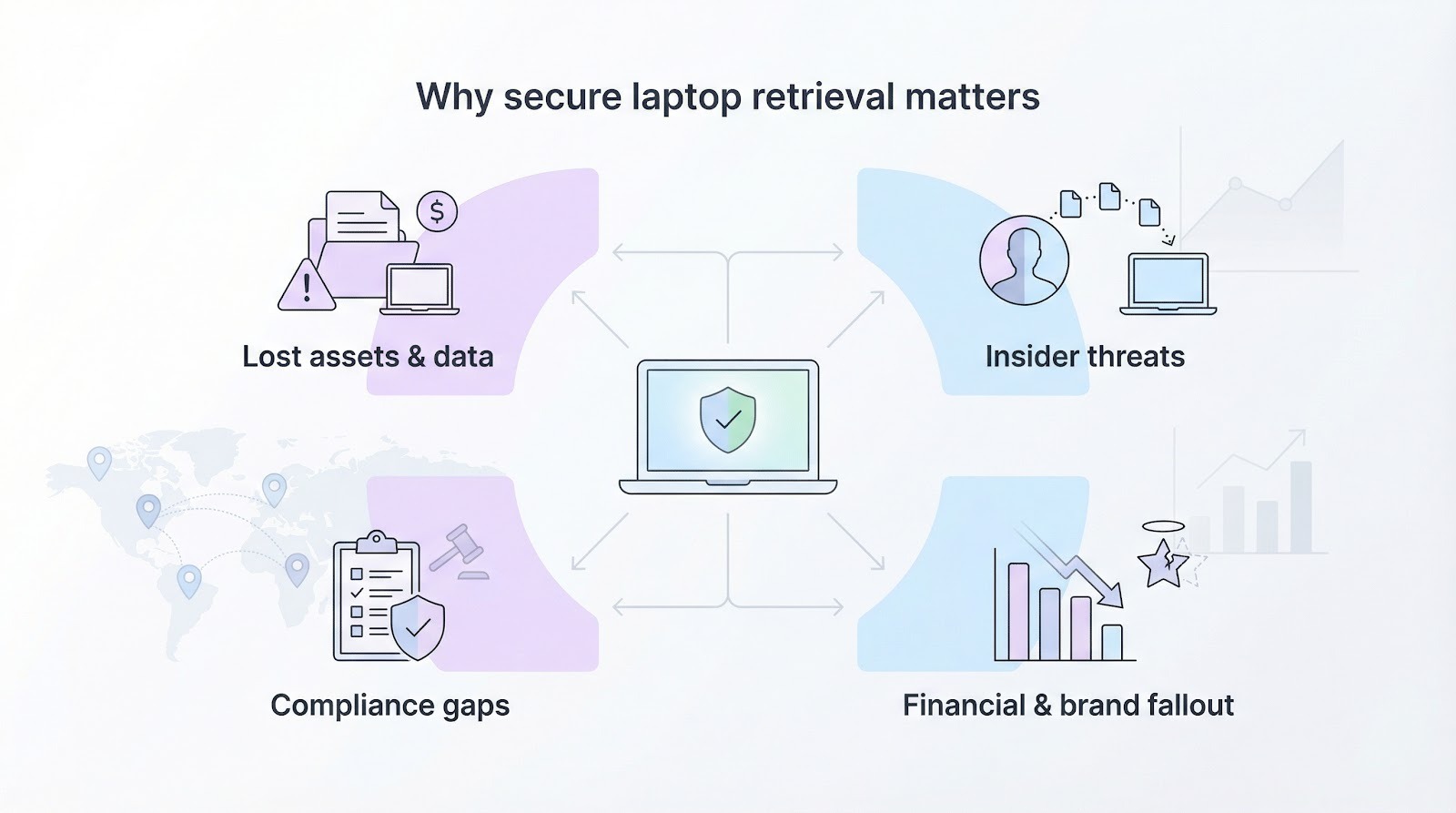
Lost assets put data, and dollars, at risk.
Remote off-boarding feels simple: fire off an exit email, lock the account, ship a box. Yet half of IT leaders admit they still lose at least five percent of company devices when employees depart.
Every missing laptop is more than a line item on a spreadsheet. Analysts peg the average exposure from one misplaced machine at roughly $50,000 once you factor in breach investigations, intellectual-property leaks, and replacement gear.
Multiply that by a round of layoffs and the math turns punishing fast. Hardware costs jump, legal teams brace for compliance fallout, and your cybersecurity stack suddenly has a blind spot you can’t patch.
In short, letting laptops “walk” isn’t a clerical error; it’s an avoidable, six-figure liability.
Insider threats spike when emotions run high.
A pink slip may end payroll, but it doesn’t erase admin rights, local files, or cached credentials. In the fog of a mass layoff some employees feel entitled to “their” laptop, along with the proprietary code or client lists stored inside.
Security teams call this digital baggage. It surfaces when frustrated alumni clone repos, forward sales contacts, or keep machines as a bargaining chip during severance disputes. Industry reports show insider incidents climbing nearly fifty percent in just two years, and termination events sit at the top of the trigger list.
The takeaway is direct: the longer an unreturned device stays in the wild, the more time a disgruntled insider has to copy, sell, or leak company secrets. Swift, trackable pickup closes that window before resentment turns into a headline-worthy breach.
Compliance and data privacy demand proof, not promises.
Regulators do not care that an employee lives on another continent. If a laptop holding personal data disappears, the liability lands on your desk. Frameworks such as GDPR and SOC 2 require evidence that hardware stayed under controlled custody and received a certified wipe.
That evidence cannot live in a Slack thread. You need a paper trail: serial numbers scanned at pickup, tamper-evident seals logged on arrival, wipe certificates archived with timestamps. When legal asks for “show me,” you want a PDF, not a shrug.
A mature retrieval partner automates those receipts. Each scan feeds an audit log, so you can answer auditors in minutes instead of launching a week-long scavenger hunt across couriers and mailrooms.
Financial and brand fallout hits harder than hardware costs.
Late laptops slow everything. Recruiters stall new hires because IT can’t re-image machines that never came back. Purchasing scrambles to order replacements at rush-shipping rates, and Finance reopens budgets that were supposedly locked.
Meanwhile, word travels fast. Alumni swap stories about companies that chased them for gear months after exit. Prospective candidates read those threads and wonder if the culture values people or paperwork. Vendors question whether your asset logs match reality.
The cash drain is concrete, but the reputational tax lingers longer. When off-boarding feels disorganized, trust erodes on both sides of your walls. A polished retrieval workflow shows that you manage details, respect departing employees, and guard customer data with equal care.
How we built the scorecard
We started where your team would: Google. We ran twenty keyword combinations such as “laptop return service,” “equipment retrieval for remote teams,” and “secure IT pickup.” The search results surfaced familiar vendors alongside a few newcomers.
From that list we shortlisted a dozen providers that cover at least two continents and publish a documented data-wipe process. Marketing copy alone did not qualify; every claim had to appear in product docs, pricing sheets, or third-party reviews.
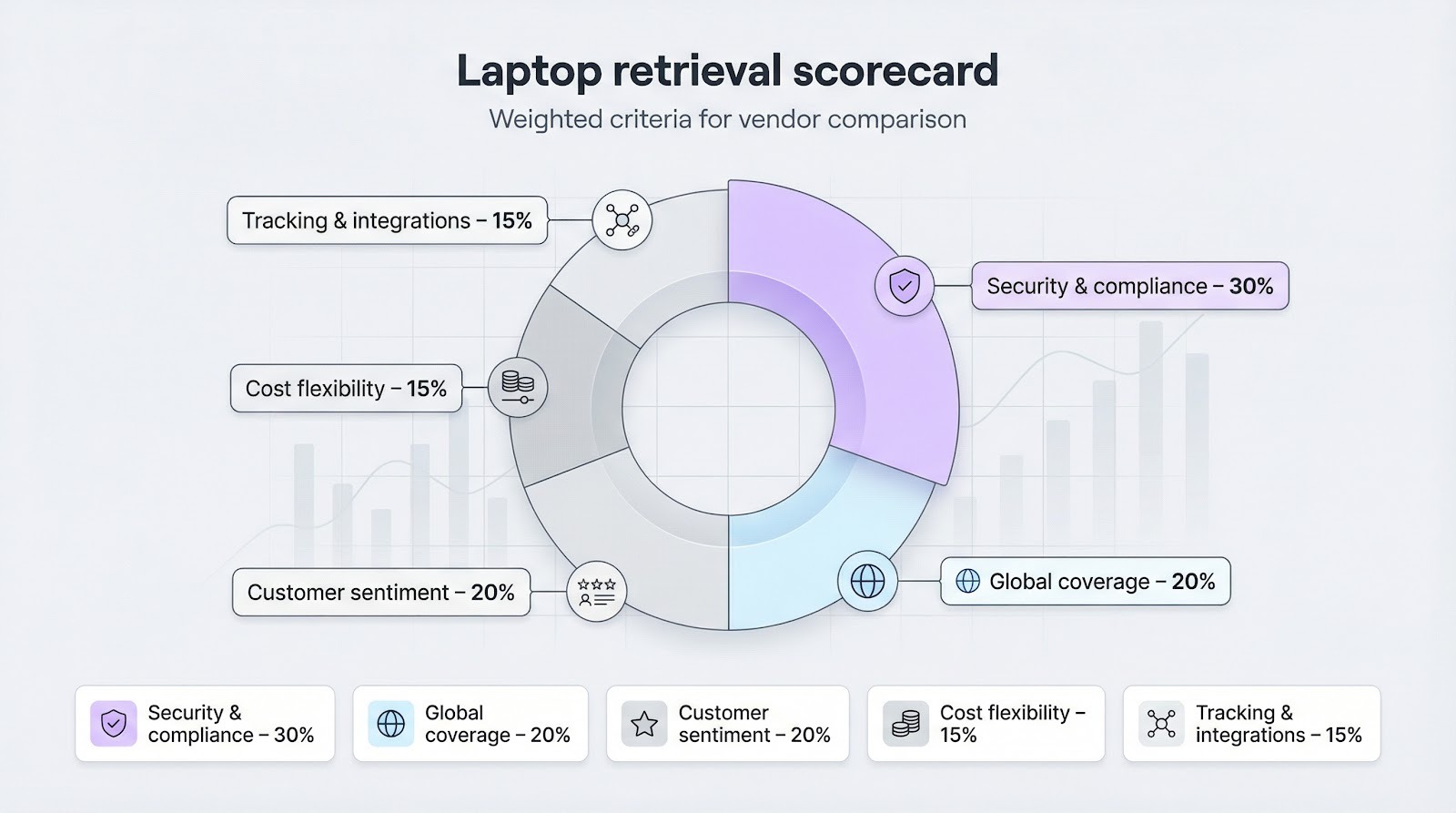
Next we defined five criteria and weighted them to match real off-boarding pain:
- Security and compliance – 30 percent
- Global coverage – 20 percent
- Cost flexibility – 15 percent
- Tracking and integrations – 15 percent
- Customer sentiment – 20 percent
Heavier weights sit where risk is highest because losing data or failing a SOC 2 audit hurts more than paying a few extra shipping dollars.
Finally, we scored each vendor on a ten-point scale, applied the weights, and let the numbers decide the podium. Opinion stayed on the sidelines so you can compare options with clear eyes.
Top 7 secure laptop pickup services
Before we explore the scores, let’s meet the contenders. Each provider can move a laptop from a departing employee’s kitchen table to a secure depot, yet they follow different routes to reach the same goal. We’ll start with the global heavyweight that set the early standard.
GroWrk: the 150-country powerhouse.
If your workforce spans every time zone, GroWrk is often the first call. The platform pairs an asset-tracking dashboard with on-the-ground logistics partners in more than 150 countries.

GroWrk global IT device lifecycle management homepage screenshot
That reach matters. Instead of shipping a laptop from São Paulo to Seattle, GroWrk routes it to a local Brazilian facility, wipes the drive to certified standards, and updates your dashboard in real time. Fewer customs delays, faster redeployment, happier finance team.
IT leaders also value the end-to-end scope. GroWrk can buy the MacBook for a new hire, store a spare charger, retrieve the device when the employee exits, and recycle it under e-waste rules when the hardware ages out. Everything shows up in one pane of glass: serial numbers, chain-of-custody scans, and data-wipe certificates.
The catch is price predictability. GroWrk runs on a subscription model tied to headcount, not usage. If you keep a large bench of contractors who churn only a few times a year, you may pay for capacity you rarely tap. For fast-growing or turnover-heavy teams, though, the flat fee can feel like insurance: unlimited pickups whenever you need them.
In short, GroWrk offers maximal coverage with minimal manual work. You trade some budget flexibility for the convenience of one global partner who seldom says, “Sorry, we don’t service that country.”
Workwize: one subscription, everything returns.
Workwize sells simplicity. Pay a flat monthly fee, usually 15 to 20 dollars per employee, and the platform handles procurement, retrieval, and even the ergonomic chair nobody wants to ship back to UPS.
For HR, that means a single contract and one dashboard covering more than 100 countries. Trigger an off-boarding in BambooHR and a prepaid box appears at the former employee’s door within a few days. Tracking links flow into the Workwize portal, so IT sees when the device scans in, Finance sees when the cost center closes, and Compliance sees the wipe certificate.
Because pricing is all-you-can-eat, budget talks stay calm. No surprise invoices after a sudden spike in exits. The downside is paying during quiet months. If you run lean and turnover swings wildly, unused subscriptions can feel like rent on an empty warehouse.
Exclusivity is another limitation. Workwize wants every region and every asset under its roof. If you already rely on a local specialist in Japan or a courier in Nairobi, expect to migrate or negotiate carve-outs.
Choose Workwize when predictability matters more than penny-perfect cost control and when you prefer one broad, deep relationship over a patchwork of regional vendors.
Allwhere: lifecycle logistics for mid-market teams.
Allwhere sits between boutique and behemoth providers. Its streamlined equipment retrieval program ships a padded, recyclable kit with a prepaid return label and gives admins real-time tracking on every scan—so no one wonders where the laptop went. The company covers about 27 countries, focusing on North America and Europe where many hybrid tech firms cluster. If that matches your footprint, you receive premium service without paying for regions you never visit.
Redeployment is the standout feature. A returned MacBook can be wiped, warehoused, and reassigned to your next hire in the same dashboard, with no spreadsheets and no shipping labels layered over old labels. HRIS triggers handle the flow: a termination in Workday schedules a pickup, and a signed offer schedules a fresh delivery.
Security meets strict audit needs. Every return kit includes a tamper seal, serial-number scan, and a wipe certificate that lands in your inbox before the courier reaches the warehouse gate. Auditors like the trail, and IT rests easier knowing no rogue SSDs cross borders.
There are trade-offs. Allwhere works best when you can forecast volume. One-off returns are allowed, but pricing stays sharp when your hiring and off-boarding cycles run steadily. Coverage in Asia-Pacific remains limited, so global giants may need a second partner to close that gap.
For mid-sized companies that want end-to-end device management without a mega-vendor contract, Allwhere offers a balanced mix of automation, security, and reuse that keeps both finance and sustainability teams satisfied.
Firstbase: flat-rate predictability with a sleek interface.
Firstbase was early to the remote-equipment space, and it shows. The user experience feels refined, from the onboarding wizard that orders a laptop to the off-boarding flow that emails a return label the moment HR flips a status in your system.
Pricing is the headline. You pay one flat seat fee, usually billed annually, unlocking deployments, swaps, returns, and even basic IT support tickets. Finance always knows the bill, and IT never debates whether a retrieval is “worth it.”
Coverage spans about 95 countries. That reach suits most distributed teams, though global enterprises will spot a few blanks on the map. Turnaround is solid, often seven to 14 days door to depot for international legs.
Two wrinkles stand out. First, exclusivity: Firstbase wants to be your only device vendor, so mixing and matching regionally is tough. Second, you pay whether hardware is moving or not. During a hiring freeze, subscription dollars keep flowing while boxes sit idle.
If you value smooth automation and can forecast a steady headcount, Firstbase offers a set-it-and-forget-it approach that lets busy IT leaders focus on higher-value work instead of chasing shipping numbers.
Quipteams: pay-as-you-go speed in 130 countries.
Quipteams keeps billing simple. Instead of subscriptions, you pay per retrieval, usually between 80 and 150 dollars depending on the country, and move on. No minimums, no platform fees.
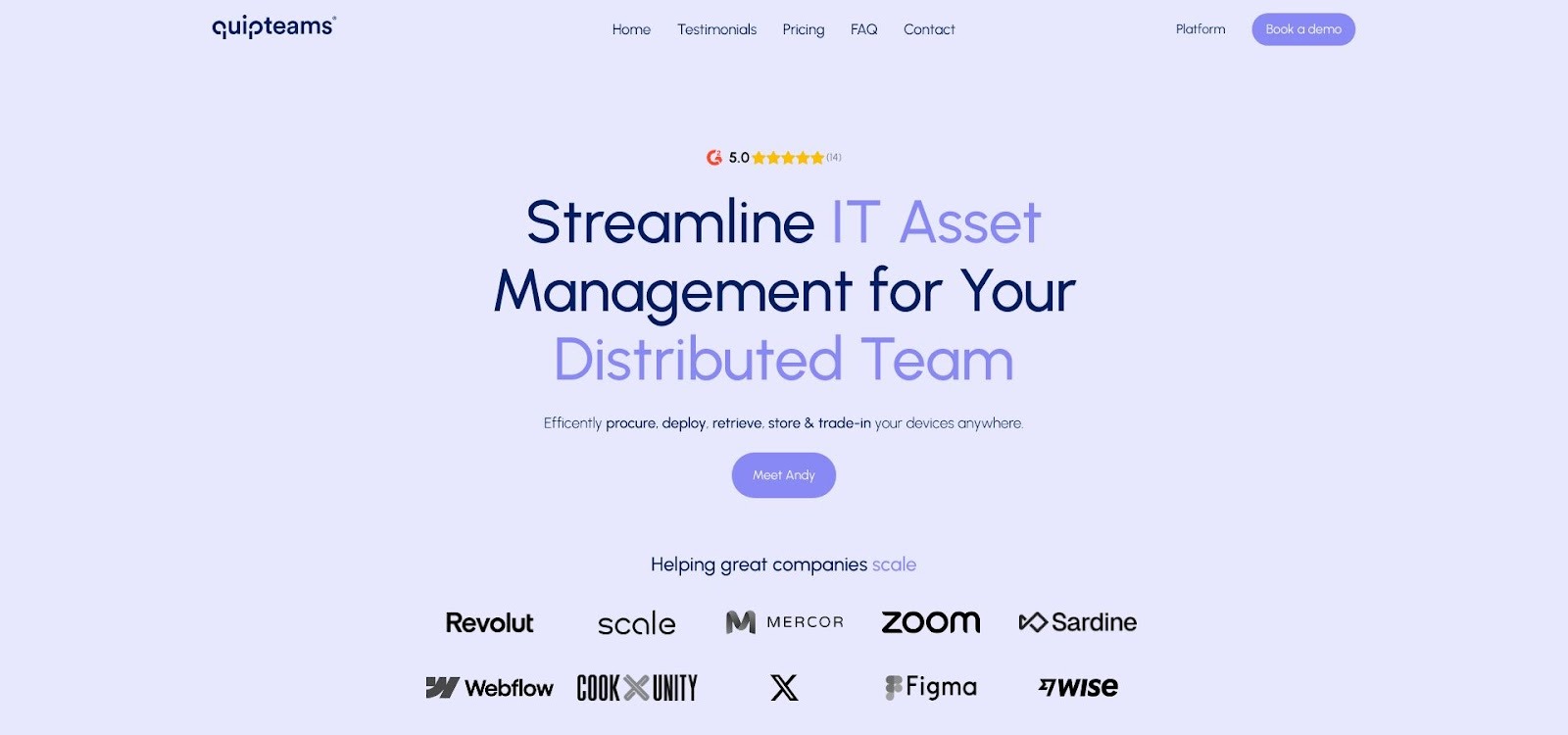
Quipteams pay-as-you-go global laptop retrieval homepage screenshot
Despite the casual pricing, the infrastructure is robust. Quipteams partners with local logistics teams in about 130 countries and posts average return times of four to seven days door to depot. Local drop-offs keep laptops inside national borders, so customs delays disappear and data never crosses jurisdictions it shouldn’t.
Security ranks high. Each inbound device receives a NIST 800-88 wipe, the chain-of-custody log updates in real time, and a destruction certificate lands in your inbox before the asset tag cools. HRIS integrations fire automatically, so ending employment in Rippling schedules a pickup while you are still on the exit call.
Two caveats apply. First, Quipteams is young. Early adopters praise support, but the company has not yet handled a client requesting 500 pickups within 48 hours. Second, if your turnover runs consistently high, the per-unit fee can exceed a flat subscription across a fiscal year.
For organizations with spiky or uncertain off-boarding volumes—think startups trimming budgets or enterprises planning a one-time reduction in force—Quipteams turns laptop retrieval into a pure variable cost without compromising reach or rigor.
Hofy (now Deel Equip): sustainability meets global scale.
Hofy earned its reputation with eco-focused device programs and caught the eye of Deel, which acquired the company in 2023. The service still runs much the same; now it plugs into Deel’s HR platform, a plus if you already use Deel for global payroll.
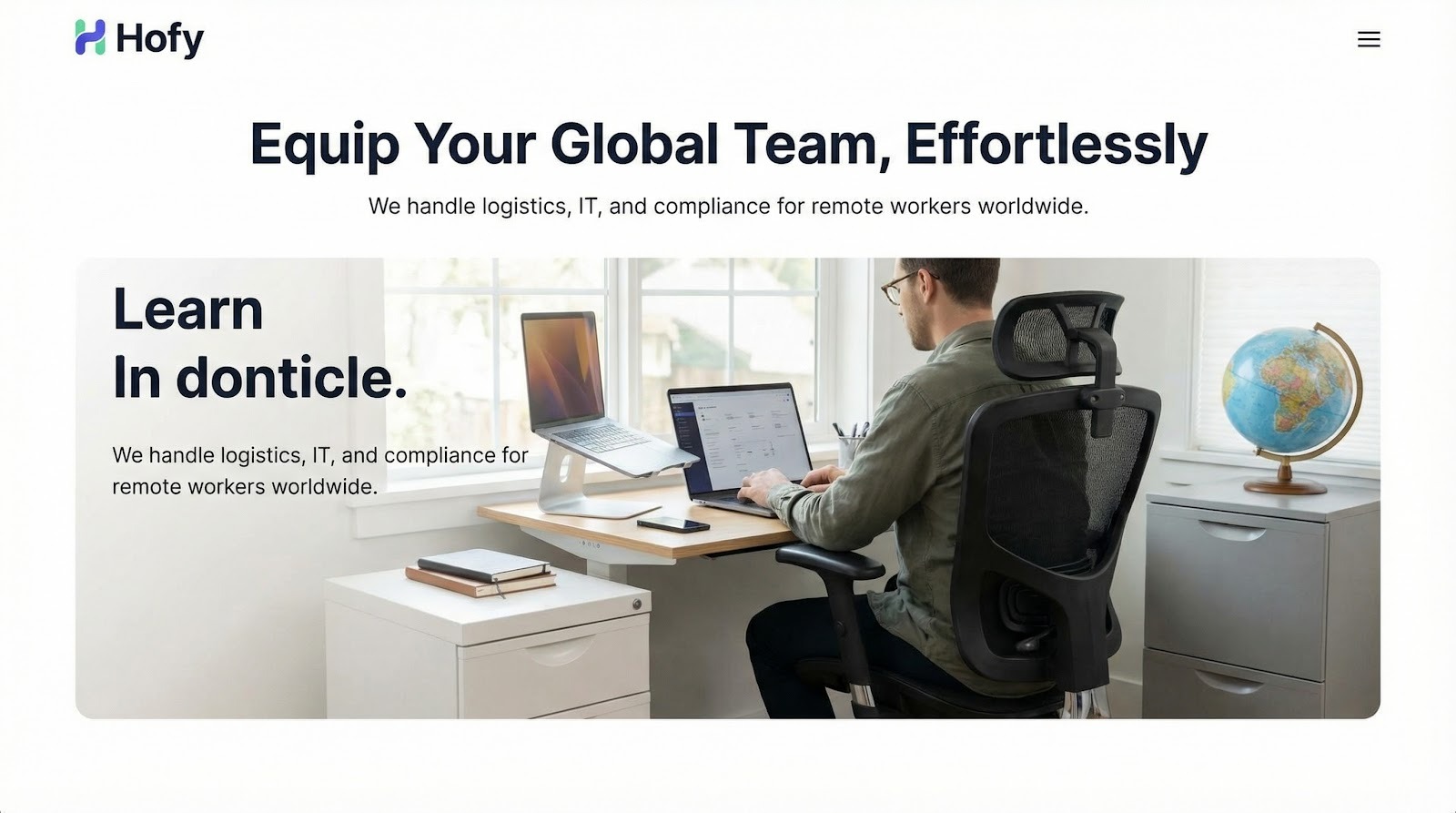
Hofy (Deel Equip) sustainable device lifecycle management homepage screenshot
Coverage spans about 120 countries. Laptops, monitors, phones, and even office chairs travel on the same logistics rails. Returned devices are graded, refurbished, and redeployed when possible. Anything beyond rescue follows certified e-waste and donation channels, and Hofy sends quarterly CO₂-savings reports that keep ESG managers happy.
Automation competes with the best. Off-boarding an employee triggers a pickup, updates the asset ledger, and notifies Finance about any depreciation claw-backs. A loaner program keeps remaining staff productive if their gear fails mid-project, a benefit few rivals match.
Complexity is the trade-off. The interface packs procurement rules, policy engines, carbon dashboards, and more. Expect onboarding sessions rather than quick-start videos. Pricing is also subscription-based, with device-lease or seat-fee models that keep charges active during downtime.
Choose Hofy when sustainability is a key metric, you want deep workflow automation, and your team has time to master a detailed platform.
Retriever: no-frills pickups across the US and Europe.
Retriever keeps the message short. You request a pickup, they email the former employee a prepaid label, and a tamper-proof box arrives. When the laptop reaches their depot, a wipe report lands in your inbox. Cost is about ninety-five dollars per device inside core markets, with no contracts and no seat fees.
That stripped-down model fits small HR teams or firms that off-board only a handful of people each quarter. It also serves as a fallback when your main provider cannot cover a single exit in Kansas or Cardiff.
Limits are clear. Retriever operates mainly in the United States, the United Kingdom, and the European Union. Need a pickup in Manila or Nairobi? You will need another option. There is no inventory storage, refurbishment service, or HRIS integration—only shipping and wiping. If you suddenly need hundreds of boxes, coordination happens through email threads rather than a high-capacity dashboard.
In brief, Retriever is straightforward, affordable, and focused on one job. Keep the service in mind for domestic one-offs or as a safety net when broader platforms get stuck on edge cases.
Comparison at a glance
Choosing between seven solid options can feel like splitting hairs. To make the trade-offs visible, we rolled every data point (security controls, global reach, pricing model, tracking features, and customer sentiment) into a weighted ten-point scale. Security holds the heaviest weight at thirty percent because a flawless pickup means nothing if the SSD is still readable.
Service
Overall score
What lifts it
What drags it
Quipteams
8.9
NIST-level wipes and pay-only-when-used pricing
New brand, untested at large scale
GroWrk
8.3
Coverage in 150+ countries, SOC 2 controls
Headcount subscription costs during quiet months
Hofy (Deel)
7.7
Sustainability reports and broad device range
Complex platform requires training
Firstbase
7.6
Smooth automation, flat per-seat budget
Pay even when hardware sits idle
Workwize
7.5
One contract for gear and furniture
Must use them everywhere or nowhere
Allwhere
7.5
Fast redeploy and tight chain-of-custody
Limited Asia-Pacific footprint
Retriever
7.3
Lowest-cost domestic one-offs, zero commitment
US/EU only, limited dashboard tools
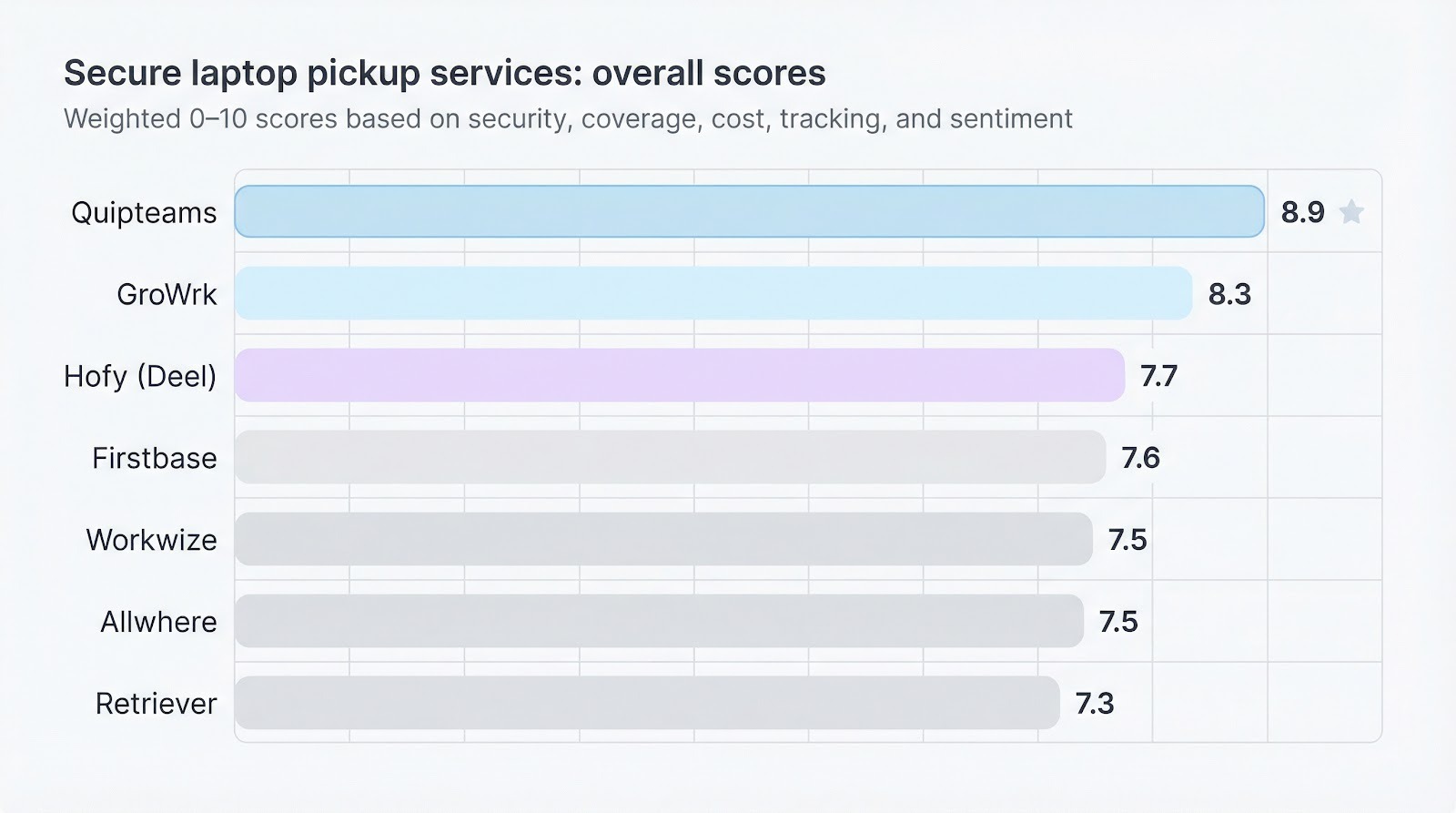
Scores are guideposts, not gospel. A company with three offices in Berlin and Boston could rank Retriever higher than GroWrk on real-world fit. Still, the table shows a pattern: vendors that pair strong security certifications with flexible cost models rise to the top, while those with rigid pricing or regional gaps fall a few points lower.
Conclusion: how to choose the right laptop pickup partner
Start with geography. Map where your current and future employees live, not just headquarters. If departures span five continents, a regional courier will falter. Look for a provider with at least one-hundred-country coverage or verified local depots in your hotspots. Coverage equals security; every gap is a risk window.
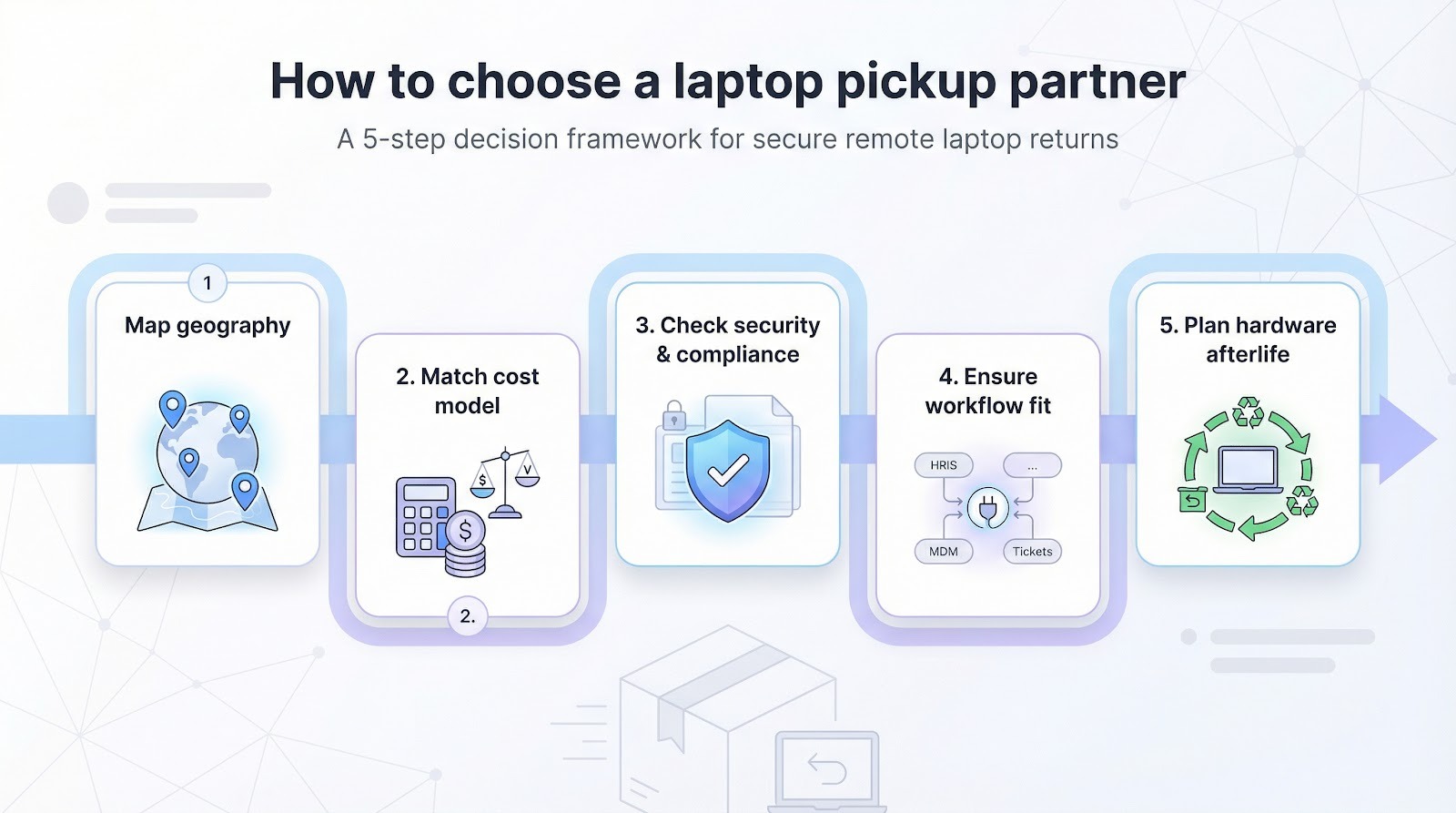
Next, match the cost model to your turnover rhythm. If off-boarding comes in unpredictable waves, pay-per-use services such as Quipteams or Retriever keep expenses flexible. High, steady churn favors flat subscriptions. Finance can lock a budget number and stop asking why invoices jump after every reorg. Run the math: annual seat fees versus projected per-device pickups. One line in Excel usually reveals the cheaper path.
Security and compliance outrank convenience. Ask blunt questions: Do you issue NIST 800-88 wipe certificates? Are couriers background-checked? Can you show the last SOC 2 audit letter? Providers proud of their controls deliver documents, not adjectives. If you operate under GDPR or HIPAA, demand proof that data never leaves approved jurisdictions.
Workflow fit saves headspace. The best service plugs into your HRIS, MDM, or ticketing system so pickups fire automatically when HR ends employment. If you rely on Slack reminders and spreadsheets today, choose a vendor that supplies the missing automation instead of another silo.
Finally, consider the afterlife of the hardware. Some teams redeploy laptops to new hires within days; others sell or recycle old gear for carbon-offset credits. Pick a partner whose post-return options—storage, refurbishment, resale, or certified e-waste—match your asset strategy and ESG goals. A smooth pickup loses shine if the device gathers dust in a warehouse you never audit.

.png)
%20(1)%20(1).jpg)
%20(1).png)
.svg)


.png)
.png)


.png)


