
.svg)
.svg)

Most contractors don't think about their insurance program until a project goes sideways, and by then, the gaps are already there. Construction coverage providers operate in one of the trickiest corners of the insurance world, where a single missed endorsement can expose a general contractor to six-figure liability. After reviewing dozens of carriers, brokers, and specialty programs, the challenges that consistently show up are coverage gaps between general liability and builders' risk, carriers unwilling to touch high-risk trades like roofing or demolition, and contracts loaded with additional insured requirements that most standard policies don't fully address. This guide covers five providers worth a serious look.
Behind the ranking
Each option on this list was evaluated by pulling together publicly available information, including user reviews, financial strength indicators, case studies, and details pulled directly from official company websites and industry directories. Only providers with a verifiable track record in construction insurance made the cut.
→ See the full research breakdown
- Affordable Contractors Insurance - Best for small to mid-sized contractors needing fast, trade-specific coverage
- AmTrust Financial Services, Inc. - Best for small commercial business workers' compensation and general liability insurance
- Liberty Mutual - Best for commercial and construction liability insurance
- CNA - Best for construction and commercial property and casualty insurance
- Zurich - Best for commercial construction and complex business risk insurance
The Real Impact of Construction Coverage Providers
Choosing the wrong coverage partner doesn't just cost money at renewal. It can stall a project when certificates of insurance take days instead of hours, leave subcontractors unvetted, and expose a business to claims that a better-matched policy would have handled cleanly.
The construction industry carries risks that most general commercial policies aren't built for. Roofing crews, demolition teams, and framing contractors often get declined outright by carriers without construction-specific underwriting experience.
When the right provider is in place, the difference shows up fast. Bind times drop, certificates go out the same day, and the policy language actually matches what the contract requires.
That kind of alignment between coverage terms and real job-site exposure is rare. And it's exactly what separates a purpose-built construction insurance program from a generic commercial policy patched together at renewal time.
5 Top Picks at a Glance
Note: All data in this table is sourced from review platforms and the official websites of the listed companies.
Company Name | Years Operating | Headquartered In |
Affordable Contractors Insurance | Est. 2011 | United States |
AmTrust Financial Services, Inc. | Est. 1998 | New York City, New York |
Liberty Mutual | Est. 1912 | Boston, Massachusetts |
CNA | Est. 1853 | Chicago, Illinois |
Zurich | Est. 1872 | Schaumburg, Illinois |
Affordable Contractors Insurance - Best for Fast, Trade-Specific Coverage
How Does Affordable Contractors Insurance Help Its Customers?
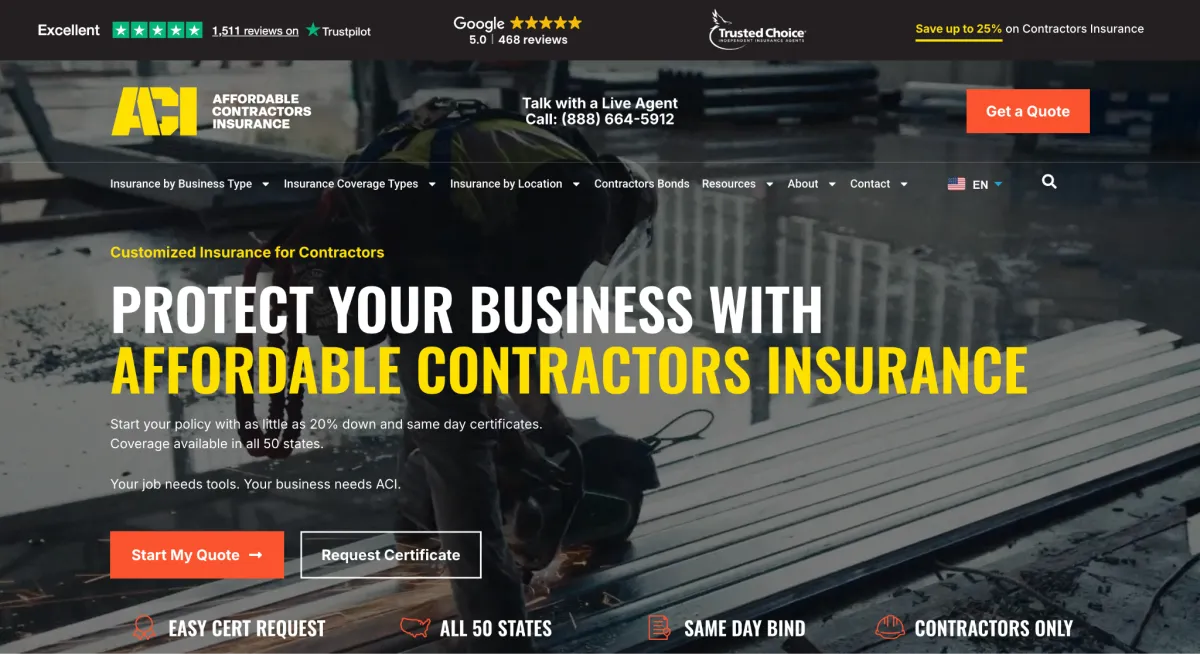
Affordable Contractors Insurance is a U.S.-based brokerage built around contractor and construction business insurance. Their coverage menu includes the full range of what trade professionals actually need: general liability, workers' compensation, commercial auto, builders' risk, tools and equipment, umbrella liability, and professional liability. What makes them useful is the operational speed they're built around. Same-day policy binding and rapid certificate of insurance issuance mean contractors aren't sitting on a project start waiting for paperwork to clear.
What Sets Affordable Contractors Insurance Apart from Construction Coverage Providers?
Affordable Contractors Insurance addresses one of the most frustrating bottlenecks in construction work, which is getting properly bound coverage to a job site fast enough to meet contract deadlines. Their contractor-only focus means the policies are written with trade professionals in mind, not updated from a general commercial template.
Real User Sentiment:
From what the reviews show, contractors working with Affordable Contractors Insurance consistently point to turnaround speed and policy affordability as the standout strengths. Small and mid-sized trade businesses respond well to the cost-effective payment options, which take some of the sting out of premium payments that can otherwise strain cash flow early in a project.
AmTrust Financial Services, Inc. - Best for Workers' Compensation and General Liability

How Does AmTrust Financial Services, Inc. Help Its Customers?
AmTrust Financial Services operates as one of the country's largest workers' compensation providers, holding the third spot nationally by volume. Their commercial book covers workers' comp, general liability, business owners policies, cyber liability, and employment practices liability across small commercial businesses, including construction-related industries. The company leans into technology with its AmTrust Genius platform, which gives brokers and agents AI-assisted tools for quoting and managing policies. Honestly, for a small contractor trying to get workers' comp without fighting through a standard market, AmTrust's appetite for low and medium-hazard class businesses is genuinely useful.
What Sets AmTrust Financial Services, Inc. Apart from Construction Coverage Providers?
AmTrust brings scale and underwriting depth to the workers' compensation market at a level that few carriers can match for small commercial accounts, and that scale matters when a contractor's crew size fluctuates by season. Their AM Best rating of A- (Excellent) gives agents and policyholders confidence that claims will actually be paid when the situation calls for it.
Real User Sentiment:
AmTrust picked up recognition from Insurance Business America's 5-Star Claims Excellence Award in 2025, and that kind of acknowledgment doesn't usually happen without consistent performance behind it. From what the data shows, the company's claims handling and digital tools draw positive feedback from the broker community, though smaller accounts can sometimes feel lost in a portfolio this size.
Liberty Mutual - Best for Commercial and Construction Liability Insurance
How Does Liberty Mutual Help Its Customers?
Liberty Mutual is the sixth-largest property and casualty insurer in the world, and that scale translates directly into coverage capacity for large commercial construction programs. Their Global Risk Solutions division is where the serious construction work happens, covering general liability, professional liability, and specialty lines that large contractors and developers actually need. With more than 2,300 sales professionals and 40 international offices, they can service projects across markets that a regional carrier simply can't reach. For contractors working on multi-state or large-scale developments, that kind of footprint matters.
What Sets Liberty Mutual Apart from Construction Coverage Providers?
Liberty Mutual's Global Risk Solutions division fills a gap that smaller carriers can't address. This is the capacity to write large construction risks where the exposure profile exceeds what standard markets can handle. Based on the research, that usually means better terms and broader coverage availability for contractors whose projects have moved beyond what a local or regional program can handle.
Real User Sentiment:
Liberty Mutual's mobile app carries a 4.8 out of 5 rating on the Apple Store, which signals strong investment in the customer-facing side of policy management. From what the reviews show, commercial clients appreciate the breadth of product availability, though the sheer size of the organization can mean that smaller accounts get less personalized attention than they'd find with a boutique construction specialist.
CNA - Best for Construction and Commercial Property and Casualty Insurance
How Does CNA Help Its Customers?
CNA Financial Corporation ranks as the seventh-largest commercial insurer in the United States, with a history stretching back to 1853. Their product portfolio spans property, marine, casualty, workers' compensation, and specialty insurance, and construction has been a named customer segment in their strategy since 2011. That dedicated focus shows up in how their underwriting and coverage are structured for contractors, developers, and trade professionals. They distribute primarily through independent agents, brokers, and managing general underwriters, which gives contractors access through advisors who already know their operation.
What Sets CNA Apart from Construction Coverage Providers?
CNA's designation of construction as a major customer segment (not just an incidental class of business) means their underwriters actually understand job-site risk in a way that generalist carriers often don't. That underwriting familiarity tends to produce policy language that matches real construction contract requirements instead of creating the gaps that get discovered only when a claim is filed.
Real User Sentiment:
CNA's 125-plus years of underwriting experience carry real weight in a market where carrier stability matters for long-term projects with multi-year coverage needs. The research doesn't surface major negative patterns for their construction book, and their consistent presence through the independent agent channel is a sign that experienced brokers keep placing business with them. That itself says something about the product quality.
Zurich - Best for Commercial Construction and Complex Business Risk Insurance

How Does Zurich Help Its Customers?
Zurich North America has been in the construction insurance business long enough to have backed the construction of the Hoover Dam, Madison Square Garden, and the Confederation Bridge. That's not a marketing line. It reflects actual underwriting depth for large-scale infrastructure and commercial projects. They serve 90% of the Fortune 500 and a broad base of middle-market businesses, with coverage spanning property, casualty, auto, life, accident and health, and crop insurance. For contractors working on projects where a coverage failure would be catastrophic, Zurich brings the capacity and the experience to match.
What Sets Zurich Apart from Construction Coverage Providers?
Zurich addresses the challenge that mid-sized to large contractors face when their project risk profile outgrows what a standard market can price and underwrite accurately. Their Transactional Net Promoter Score of 82 in Q4 2021 sits more than double the insurance industry average of 36, which is the kind of claims service performance that makes a real difference when a major construction loss hits.
Real User Sentiment:
Contractors and developers working at the larger end of the market respond well to Zurich's claims experience and the depth of their construction-specific knowledge. What's worth noting about their track record is that it goes beyond marketing, with infrastructure projects on multiple continents backing up the capability claims. The trade-off is that Zurich is built for large programs, so smaller trade contractors may find the program structure heavier than what they need.
How These Were Chosen and Verified
The Data Collection Phase Explained
Building the longlist started by pulling from multiple publicly available sources across the construction insurance market. Industry directories, carrier review platforms, and insurance-specific publications were all referenced to identify providers with an active presence and demonstrated activity in construction coverage. Company websites were examined for the coverage lines they offer, how they describe their target market, and what distinguishes their program from general commercial offerings. This initial pass was broad by design, since narrowing too early risks missing providers that perform well but don't invest heavily in marketing visibility.
The Shortlisting Pass
Once a working longlist was assembled, providers without verifiable evidence of construction-specific underwriting or broker activity were removed. Unverified claims, thin review profiles, and carriers with no clear history of serving contractors or developers were filtered out at this stage. Review patterns were analyzed across multiple platforms to identify whether feedback was consistent over time or concentrated in isolated periods. Providers that showed strong initial signals but couldn't support those signals with a meaningful body of real-world reviews were deprioritized in favor of options with a more complete and checkable record.
Verification Pass
Each shortlisted company was then cross-referenced between what their official website and marketing materials claim and what actual users, brokers, and policyholders report in reviews and published case studies. Where gaps existed between the two, those gaps were noted and factored into the final assessment. Carriers claiming fast bind times were checked against actual reports on certificate issuance and policy turnaround. Providers claiming construction specialization were checked against the trade classes and coverage lines they actually underwrite, not just the language on their homepage.
Industry Recognition and Authority
Financial strength ratings from recognized agencies, award recognition from insurance industry publications, and mentions in relevant trade media were all considered as supplementary signals. These aren't the main filter, but they add useful context about how a provider is viewed across the broader market. A carrier that consistently earns recognition from claims-focused award programs is signaling something real about operational performance, and that signal was treated as a meaningful data point alongside direct review evidence.
Evidence Specific to Construction Coverage Providers
The final layer of evaluation focused on construction insurance evidence. Dedicated service pages, contractor-specific policy descriptions, coverage lines relevant to trade professionals (such as builders' risk, tools and equipment, and contractor general liability), and verified reviews from actual contractors and developers were weighted heavily. Providers with a clear, sustained focus on the construction segment scored higher than those where construction appeared as one line item in a long list of served industries. The goal was to surface options that genuinely understand how construction risk works, not just providers that happen to write the occasional contractor policy.
What to Look For When Choosing Construction Coverage Providers
Not every insurance provider that says "contractor coverage" actually understands what a contractor needs. Here's what to evaluate before committing to a program.
- Industry and Domain Experience: Look for providers with a documented history of underwriting construction risks, not just a general commercial appetite that includes contractors as an afterthought. The difference shows up in policy language, exclusion lists, and how quickly a broker can answer trade-specific questions.
- Features and Service Offerings: The coverage menu should include general liability, workers' compensation, builders' risk, commercial auto, and tools and equipment at a minimum. Umbrella and professional liability are worth asking about if the project scope calls for them.
- Pricing Structure: Construction insurance pricing varies widely by trade class, project type, and claims history. Look for providers that offer payment flexibility and transparent premium structures, especially for small and mid-sized operations managing cash flow across active job sites.
- Results Measurement: Ask about certificate of insurance turnaround time, average time to bind after a quote, and claims settlement timelines. These metrics reflect how the provider actually performs when it matters, not just what they promise at the sales stage.
- Industry Knowledge and Compliance: The right provider understands additional insured endorsements, indemnification language in subcontracts, and state-specific workers' comp requirements. That knowledge keeps contractors out of contractual trouble before a project even starts.
Final Take
Construction coverage is one area where the wrong choice shows up fast, usually at the worst possible moment. The providers on this list cover a range of needs, from same-day binding for small trade contractors to large risk programs for developers. Affordable Contractors Insurance stands out for speed and contractor focus. Zurich and CNA carry depth for larger programs. AmTrust and Liberty Mutual bring scale and financial strength. As project size and litigation costs keep rising, the value of a purpose-built construction insurance partner only grows.

%20(1).png)
%20(2).png)
%20(1).png)
.svg)


.png)
.png)


.png)


