
.svg)
.svg)

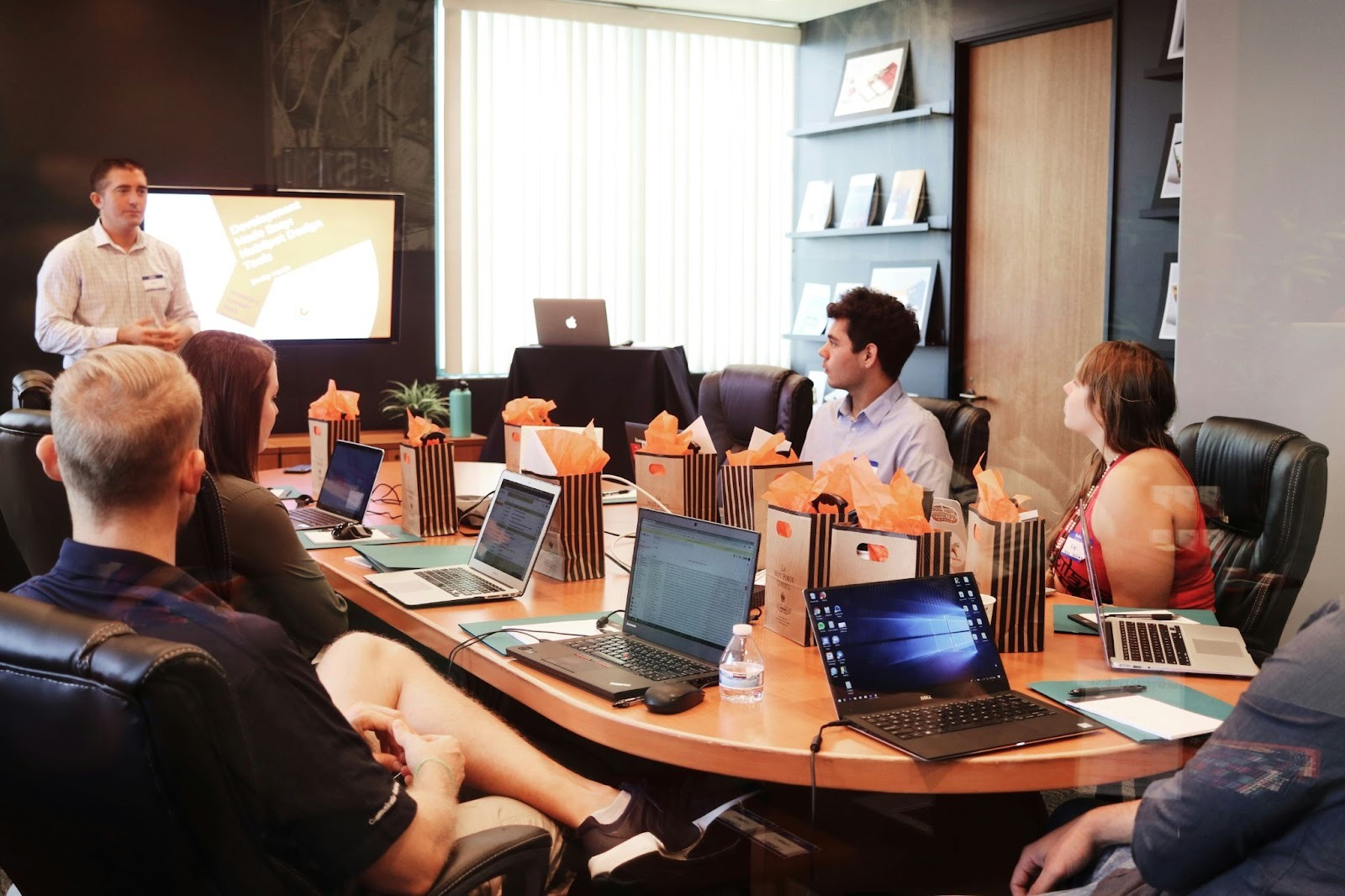
Photo by Campaign Creators from Unsplash
In the modern-day competitive business environment, there is pressure on HR departments to utilize AI to enhance talent management in their recruitment and onboarding, as well as in tracking and retaining performance. However, why then, in the era of popular AI tools, does HR tech still demand custom software development? Generic solutions can be inefficient because they do not deal with specific work processes, cultural peculiarities, or industry policies. This piece will discuss the argument for tailor-made solutions, demonstrating how tailored software solutions combined with AI can offer better scalability, accuracy, and effectiveness when it comes to HR software development.
The Downsides of Off-the-Shelf Solutions in HR Tech
The platforms of generic HR are fast to deploy, but are starting to show weaknesses as AI transforms expectations. Such systems provide standardized payroll, applicant tracking, or simple analytics modules, but fail to meet the demands of real-life HR businesses.
Key Technical Shortcomings
In terms of development, off-the-shelf products usually support monolithic architectures and proprietary databases, which are not easy to integrate with AI. The reality is that this poses continued problems:
- Data Silos and Integration Barriers:
Only a few APIs allow for maintaining a smooth flow of data to more sophisticated machine learning pipelines, which must be exported manually, resulting in higher error rates.
- Hard-coded Algorithms:
Hard-coded automation relies on simple, rule-based reasoning instead of flexible models and does not support contextual variables such as regional compliance or work-at-home policies.
- Performance Bottlenecks:
With a growing volume of data (resumes, feedback forms, performance logs), these systems are exposed to query latency, particularly when trying to perform NLP-based parsing.
Real-World Consequences
Cultural differences in the styles of feedback in multinational organizations require sentiment models trained on company-specific language patterns, which generic platforms cannot realize without expensive and delicate add-ons. The outcome is a lag in understanding and compliance risks, as well as a lack of opportunity to forecast turnover or skill shortages.
The Reason Custom Software Development is Important to AI-Enhanced HR Systems
The way to create truly intelligent HR tech is with the help of custom software development, which creates the systems that reflect the unique processes and purposes of the organization. It does not impose workflows in a certain pre-determined shape, but allows getting everything aligned at the beginning.
How Specialized Expertise Helps
Working with the following AI development company, for example, helps in faster transformation. These providers are capable of providing end-to-end custom AI software development services, including the initial architecture design, deployment, and continuous optimization. They build modularized microservice systems that help them combine proprietary HR information with the latest AI models, e.g., fine-tuned large language models to coach people personally based on their careers or computer vision to analyze video interviews.
Such services highlight secure, compliant deployments, with added support for embedding differential privacy mechanisms and encrypted data pipelines to fulfill GDPR, CCPA, or local labor requirements. Through the ability to reuse AI components and write modular codebases, a development cycle can be significantly reduced and become much more accurate. This narrow specialization in custom AI development services ensures that HR platforms transform themselves into a strategic instrument, delivering quantifiable ROI in the form of reduced administrative overhead and increased talent outcomes.
Architectural Advantages
The custom solutions are usually based on containerized deployment (e.g., Kubernetes orchestration), event-driven patterns, which enable independent scale of AI inference endpoints without interfering with core HR operations. This modularity is critical in HR software development, as functionality such as sentiment dashboards in real-time or predictive attrition models needs low-performance access to streaming data.
Incorporating AI Software Development in HR Processes
The emerging AI software development can take HR technology to the next level of anticipation, rather than automation, but only when incorporated intelligently via bespoke avenues.
Integration Process
To implement AI successfully, an organization must follow the technical process that is structured in the following way:
- Requirement Mapping and Audit: Conduct a thorough system audit with profiling tools in order to pinpoint the bottlenecks—e.g., slow joins of the employee databases or unstructured text fields.
- Architecture Blueprinting: Design a layered stack. Data lake: Data to be transformed into raw data with frameworks such as TensorFlow Serving or TorchServe variety of features. Engineered variables: Feature store component Frameworks like TensorFlow Serving or TorchServe Model serving layer: Data to be transformed into features architecture
- Data Pipeline Construction: Construct powerful ETL tools like Apache Airflow using tools like data validation, anonymization scripts, and balancing the training to ensure fair model training.
- Model Development and Validation: Train domain-specific models, e.g., transformer-based resume matching classifiers, by cross-validation, with SHAP explanations to make it transparent.
- Secure Deployment and Monitoring: Push through CI/CD pipelines through cloud infrastructure, and infer drift through Prometheus/Grafana dashboards and trigger automated retraining.
Ethical and Bias Considerations
The primary HR software development companies develop bias audits as part of every iteration, and use methods such as adversarial debiasing or fairness constraints in their optimization. This high level of technicality guarantees fair results in terms of demographics.
The Advantages of HR Software Development with Custom AI Function
Generic tools cannot achieve the compounding benefits realized by custom HR software development and AI.
Measurable Operational Profits
- Automation Degree: Custom models are able to remove 75-85 percent of repetitive work, including creating dynamic performance narratives through structured and unstructured inputs with the use of generative AI.
- Predictive Precision: LSTM networks or Prophet libraries can provide early alerts on retention risk, allowing proactive measures to be taken.
- Resource Optimization: Constraint-based scheduling algorithms reduce the overtime expenses without jeopardizing the choices of employees and legal restrictions.
- Personalization at Scale: Recommendation systems are similar to collaborative filtering in streaming services, recommending personalized learning paths depending on career paths and inventory of skills.
Long-Term Strategic Value
Custom platforms are not vendor-locked and can easily embrace new techniques, such as multimodal AI to analyze voice and video feedback, or federated learning to gain cross-subsidiary insights without centralizing sensitive data or compromising its protection.
Issues in Custom AI Software Development in HR Tech and How to Beat Them.
Overcoming General Challenges
Even strong projects do not pass without obstacles:
- Old-New Components Transition: API gateways and message queues (e.g., RabbitMQ) may be used to completely transition old and new components eventually.
- Talent and Knowledge Gaps: Work with the HR software development firms that provide special AI engineers and knowledge transfer courses.
- Budget/Time constraint: Implement agile sprints with an MVP release, prioritizing the most critical modules, such as recruitment AI.
- Model Degradation: Introduce automated monitoring pipelines to indicate accuracy decline and retrain new data distributions.
Technical anticipation of these problems by the organizations becomes road roadblock to milestones.
Conclusion
With the further automation of AI gradually revolutionizing the workplace, the necessity of custom software development in HR technology has never been more necessary. Generic solutions, however available they may be, are unable to offer the depth, flexibility, or foresight that custom systems would provide. With the careful development of HR software and the strategic integration of AI, organizations create platforms that not only simplify work but also predict future requirements. With the adoption of best technical procedures, the application of specialized knowledge, and the taking on of future challenges, HR leaders can transform their role from an administrative one to a truly strategic one. Custom AI software development is a sure way to be resilient, innovative, and competitive tomorrow, making HR the engine of sustainable organizational success.
%20(1).png)
%20(1).png)
%20(1).png)
.svg)


.png)
.png)


.png)


