
.svg)
.svg)


Video production has long depended on large teams, tight schedules, and drawn-out revision cycles. Even a short promotional clip could take weeks to move from concept to final cut, with bottlenecks at nearly every stage.
That dynamic is shifting. AI video tools now handle tasks that once required specialized roles, from rough cuts to captioning, while creative teams focus on storytelling and brand direction. The practical question is how teams assign responsibilities and keep human review in the workflow. What happens when collaborative workflows meet AI-driven video production in practice? The answer is already taking shape across industries.
What Changes When AI Joins the Video Team
The most immediate shift is practical. AI now takes over repetitive production tasks that used to consume hours of skilled labor. Auto-captioning, scene detection, rough assembly cuts, and asset resizing across platforms all happen with minimal human input.
That redistribution of effort changes how teams operate day to day. Instead of spending time on frame-by-frame edits or manual transcription, editors and producers focus on creative direction, narrative pacing, and visual storytelling.
Plan one pilot video to assess the workflow. Record the time from brief to approval, including review and rework. Compare it with your team's own baseline for a similar video measured over the same stages before deciding whether to expand AI assistance.
This shift is not a niche experiment, either. The AI video market growth projections indicate the market will expand from USD 3.86 billion in 2024 to USD 42.29 billion by 2033, reflecting how quickly organizations are integrating these tools into their creative workflows.
Short-form video is accelerating adoption further. Platforms like TikTok, YouTube Shorts, and Instagram Reels demand a constant stream of content creation across multiple formats and aspect ratios. Teams that once produced a handful of videos per month now need dozens, and automation makes that volume manageable without burning out editors.
The result is a production environment where AI handles the mechanical work and human collaborators steer the creative vision.
Building AI Into Collaborative Video Workflows
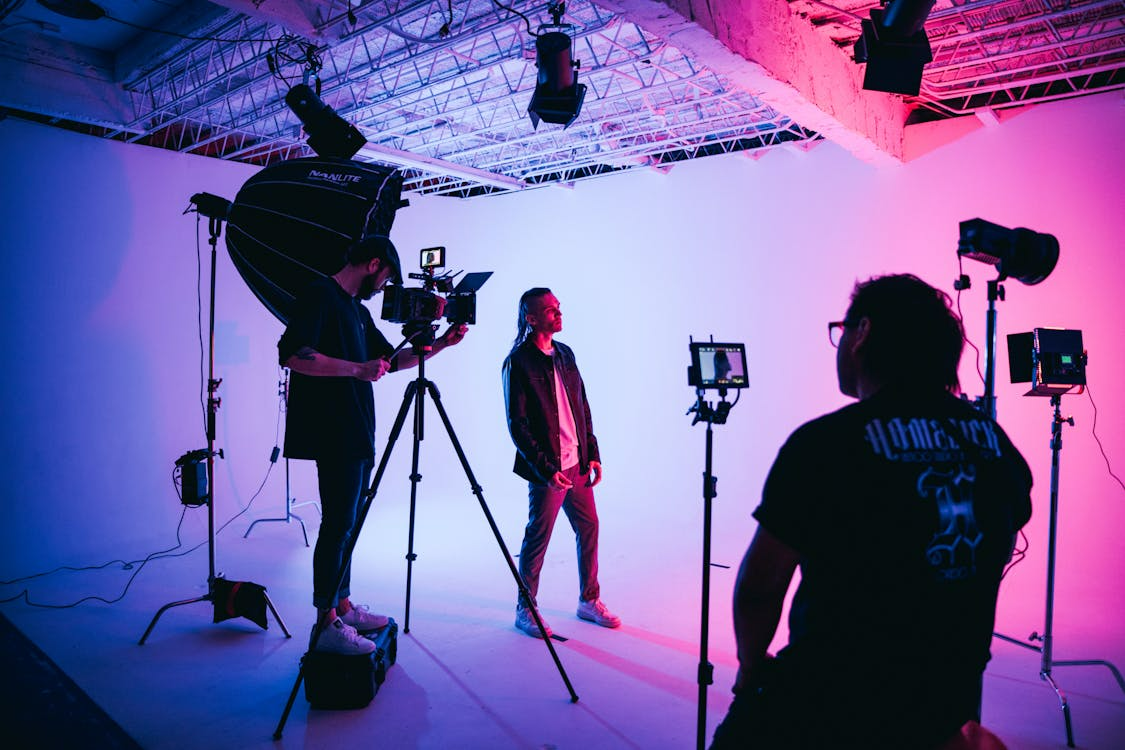
Embedding new AI tools into existing team processes without disrupting established workflows presents a real challenge. Teams need to identify where automation adds value without creating confusion about roles or handoffs. The sections below break down how that integration works in practice.
Where AI Fits in the Production Pipeline
AI tools don't enter the production process at a single point. They slot into nearly every stage, each time reducing the manual load on creative teams.
In pre-production, share a brief with the team. If useful, use AI to draft an outline, then have the brief owner review it against the audience, objective and style references. Have that owner approve the outline before moving into production.
During production, AI-powered tools handle tasks like music selection, visual asset generation, and multi-format adaptation. Teams now rely on scriptwriting assistants, auto-editors, a Freebeat music video maker, and platform reformatting tools to produce polished drafts faster while editors focus on pacing and tone.
Post-production is where automation has the most visible impact. Automated editing, color correction suggestions, and platform-specific exports reduce the hours spent on technical finishing work. Teams that use video to enhance team communication internally can apply many of these same efficiencies to outward-facing content creation.
Keeping Human Direction at the Center
For a small team, try this handoff checklist to keep creative decisions with people. One person may fill several roles, but name who is responsible for each step.
- Brief owner: Supply the goals, audience, objective and style references, along with the approved outline, so everyone works from the same creative direction.
- Operator: Identify which drafts, visuals or edits are AI-assisted. Assign each draft a version ID before handing it to the editor.
- Editor: Check claims, captions, audio and brand fit, including narrative pacing and visual style. Record any changes needed against the reviewed version before sending it to the approver.
- Approver: Act as the human release gate. Record release approval for the reviewed version, or return consolidated feedback tied to its version ID to the operator. If changes are needed, send the revised version through review again before release.
Protecting Brand Voice When AI Creates Video
AI-generated video can drift from brand guidelines quickly, especially when multiple team members use different tools or prompts without a shared reference point. Without structured review checkpoints built into the production pipeline, small inconsistencies in color, tone, or pacing compound across deliverables until the output no longer feels cohesive.
The fix starts with style guides that go beyond copy. Brand voice applies to visual identity, motion pacing, music selection, and even the cadence of on-screen text. Teams that only document their written tone leave a wide gap for AI-generated visual and audio assets to fall out of alignment.
Quality control loops work best as a two-layer system. Automated consistency checks can flag deviations in color palettes, font usage, or aspect ratios before a human ever reviews the file. Human review gates then assess the harder-to-quantify elements, like whether the pacing matches the brand's personality or whether the music feels right for the audience.
Distributed teams face an added challenge here. When editors, designers, and producers work across time zones, alignment on AI-generated outputs requires more than email threads. Collaborative productivity tools that centralize feedback and version tracking help keep everyone working from the same standards, so content creation stays consistent regardless of who reviews it or where they sit.
Ethics and Copyright in AI Video Production
Legal ownership of AI-generated video content remains unresolved in most jurisdictions. Courts and regulators are still working through how copyright applies when a machine, rather than a person, produces the visual output. That uncertainty creates real risk for teams scaling AI into their video production workflows.
Tracking which assets are AI-generated is a practical starting point. Internal logging helps teams stay ahead of disclosure requirements and compliance obligations as regulations take shape. Without that record-keeping, content creation pipelines can produce work that becomes difficult to audit later.
Training data provenance adds another layer of complexity. Some AI models rely on copyrighted material without transparent licensing, which raises questions about whether the resulting outputs carry downstream legal exposure.
Accordingly, collaborative teams benefit from establishing internal attribution policies early, before production scales to a point where retroactive compliance becomes costly. Clear guidelines on when and how to disclose AI involvement protect both the organization and its publishing partners.
Disclosure norms are still evolving across industries and platforms. Teams that adopt proactive transparency now position themselves ahead of emerging standards rather than scrambling to meet them after the fact.
The Collaborative Edge That AI Unlocks
The teams gaining the most from AI video tools are not the ones with the biggest budgets or the latest software. They are the ones that already collaborate well. Strong creative workflows, clear roles, and shared standards give AI something structured to accelerate.
AI reduces friction in production, but it does not replace creative judgment or the alignment that holds a team together. The technology handles volume and speed, while the people handle meaning, tone, and direction.
Human-AI collaboration in video content creation is still in its early stages. Teams that build disciplined processes around these tools now, rather than waiting for the technology to mature further, will be the ones best positioned to scale their output without losing creative control.
%20(1).png)
.png)
%20(1).png)
.svg)


.png)
.png)


.png)


